

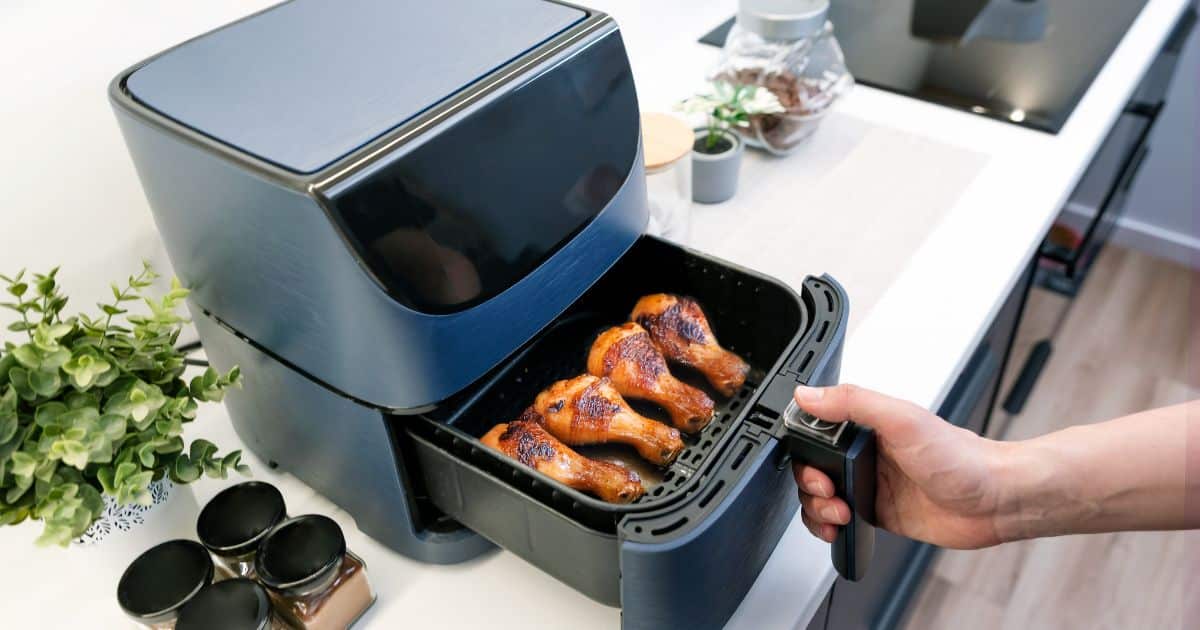
Air fryers have become a staple in many kitchens because they make it easy to prepare crispy foods with less oil and less time than traditional cooking methods. When shopping for one, however, most consumers focus on capacity, wattage, cooking presets, and price rather than asking what the cooking surface is made from. For anyone trying to create a lower-toxin kitchen, that question deserves more attention because the basket, trays, racks, and interior chamber can come into contact with food during repeated high-heat cooking.
Why Air Fryer Materials Matter
An air fryer cooks by circulating hot air around food inside an enclosed chamber. This means the surfaces surrounding the food are repeatedly exposed to heat, moisture, oils, and cleaning products throughout the appliance’s lifespan. Since an air fryer may be used several times a week for years, the materials used in its food-contact components are worth considering before making a purchase.
Marketing terms such as “premium nonstick” or “easy release” do not necessarily tell consumers what a coating actually contains. Instead, look for specific information about the basket, trays, racks, and interior walls. When manufacturers clearly identify the materials used, it becomes much easier to compare appliances based on more than appearance and features.
The Concern With Nonstick Coatings
Many conventional air fryers feature dark, nonstick-coated baskets and trays. Some of these coatings are based on fluoropolymers such as PTFE, which belongs to the larger family of per- and polyfluoroalkyl substances, commonly known as PFAS.
PFAS are a large group of synthetic chemicals valued for their resistance to heat, grease, water, and degradation. Their persistence has made them a significant subject of environmental and health research, with certain PFAS compounds associated with concerns involving immune function, cholesterol, development, reproduction, and cancer.
This does not mean that every nonstick air fryer is automatically dangerous during normal use. Modern PTFE coatings are designed to remain relatively stable within their intended temperature range, and most air fryers operate below the temperatures at which PTFE undergoes significant thermal decomposition.
The concern for some consumers is instead the presence of fluorinated chemistry itself and the possibility that coatings can deteriorate over the years of use. Scratches, chips, and general wear can change the condition of a cooking surface, which is one reason a durable, uncoated material may be preferable for a frequently used appliance.
Why Stainless Steel Is a Useful Alternative
Stainless steel is an attractive option for consumers who want to avoid fluoropolymer-based nonstick coatings. The material is durable, corrosion-resistant, and widely used in professional kitchens because it can withstand repeated cooking and cleaning without relying on a coating.
Unlike a coated surface, stainless steel does not peel or flake due to normal coating deterioration. It can develop discoloration or marks over time, but the underlying material remains the cooking surface.
There is a tradeoff. Food may stick more readily to stainless steel than to conventional nonstick surfaces, meaning it can require slightly more oil and cleaning. For consumers prioritizing durability and simpler food-contact materials, however, that may be a worthwhile exchange.
Which Parts Should Be Stainless Steel?
The phrase “stainless steel air fryer” does not necessarily mean that every component is made from stainless steel. Some appliances may have a stainless steel exterior while using coated aluminum baskets or trays inside.
Before buying, check the materials of the parts that actually touch food. Ideally, look for stainless steel cooking baskets, trays, racks, and interior cooking surfaces.
If the product description does not clearly explain the materials, check the manufacturer’s specifications or instruction manual. When information remains unclear, choosing a model with more transparent material information can make the decision easier.
Don’t Judge an Appliance by Its Color Alone
A black basket is not definitive proof that an air fryer contains PTFE or PFAS. Different manufacturers use different finishes and materials, so the appearance of a cooking surface cannot determine its chemical composition.
Instead, use the color as a reason to investigate further. Look for specific terms such as stainless steel, PTFE, fluoropolymer, ceramic coating, or other materials in the manufacturer’s documentation.
Clear labeling is valuable because it allows consumers to make decisions based on actual materials rather than assumptions.
What About Proposition 65 Warnings?
Some kitchen appliances carry a California Proposition 65 warning. Proposition 65 requires businesses to provide warnings when products may expose consumers to chemicals that California has identified as associated with cancer, congenital disabilities, or reproductive harm.
A warning does not automatically mean that an appliance is unsafe or that normal use results in dangerous exposure. It may indicate the presence of a listed chemical at a level subject to California’s warning requirements.
For that reason, Proposition 65 should be viewed as one piece of information rather than a definitive safety rating. When comparing similar appliances, consumers can consider the warning alongside the manufacturer’s material disclosures and overall construction.
More Features Don’t Necessarily Mean a Better Air Fryer
Today’s air fryers can perform far more functions than simply air frying. Many models offer settings for roasting, baking, broiling, dehydrating, reheating, and toasting, while some also connect to smartphone apps.
Those features may be convenient, but they should not distract from the appliance’s materials. A simpler model with durable, clearly identified food-contact surfaces may be a more appealing long-term choice than a highly computerized appliance with materials that are difficult to identify.
Capacity, performance, and ease of cleaning still matter. However, for a regularly used appliance, construction and durability should be part of the initial buying decision.
A Stainless Steel Air Fryer Oven to Consider
The Cuisinart stainless steel air fryer oven is an example of a construction that may appeal to shoppers who prioritize stainless steel. Its oven-style design includes stainless steel components such as racks and trays, and provides a larger cooking area than many compact basket-style models.
The useful takeaway is not necessarily the brand itself but the construction. When evaluating this or any other model, consumers should confirm the materials for the specific version they are considering, as product specifications can vary between models and over time.
How to Shop for a Lower-Toxin Air Fryer
A quick checklist can simplify the process. First, identify the material used for the basket or tray that comes into direct contact with food. Then check whether the racks and interior walls are also stainless steel or have a nonstick coating.
Next, review the manufacturer’s specifications for information about PTFE, fluoropolymers, ceramic coatings, or other finishes. If a company does not clearly disclose the material used on a food-contact surface, consider comparing it with another model that provides more detailed information.
Finally, think beyond the first year of ownership. An air fryer is a long-term kitchen appliance, so durability and the condition of its cooking surfaces after repeated use matter just as much as how attractive it looks out of the box.
How to Care for Stainless Steel Surfaces
Stainless steel can require a little more effort to clean, but maintaining it does not have to be difficult. Soaking trays in warm, soapy water can loosen food residue, while a small amount of cooking oil can help prevent sticking during preparation.
Avoiding excessively abrasive cleaning tools can help maintain the surface. Regular cleaning is important regardless of the material because accumulated food residue can affect both hygiene and appliance performance.
For many households, the additional cleanup associated with stainless steel is a reasonable trade-off for a cooking surface that does not rely on a nonstick coating.
The Bottom Line
Choosing an air fryer involves more than deciding how many cooking presets or how much capacity the appliance offers. The materials used inside the cooking chamber warrant careful consideration, as these surfaces are repeatedly exposed to heat and may come into contact with food.
For consumers who prefer to minimize potential exposure to fluorinated nonstick chemistry, stainless steel is a practical alternative. PFAS and nonstick coatings are complex topics, and normal use of a modern appliance should not automatically be viewed as dangerous, but selecting an uncoated cooking surface can be a reasonable precautionary choice.
Before buying, check the basket, trays, racks, and interior walls; review the manufacturer’s material information; and consider how the appliance will perform over the years of use. A durable appliance with transparent construction may ultimately be a better investment than one chosen primarily for its features.
Frequently Asked Questions
What is the best material for an air fryer?
Stainless steel is an appealing option for consumers who want durable food-contact surfaces without a fluoropolymer-based nonstick coating. It can require more cleaning, but it does not depend on a coating that can wear down over time.
Are nonstick air fryers safe?
Modern nonstick coatings are designed for normal cooking temperatures and are not automatically unsafe. However, many consumers prefer to avoid fluorinated coatings due to broader concerns about PFAS and the long-term condition of coated surfaces.
Does a black air fryer basket contain PFAS?
Not necessarily. The color of a basket cannot determine its chemical composition. The manufacturer’s specifications should be checked to identify whether the surface is stainless steel, PTFE-coated, ceramic-coated, or made from another material.
What should be checked before buying an air fryer?
Look at the materials used for the basket, trays, racks, and interior chamber. Prioritize clear manufacturer information, consider whether coatings are present, and evaluate durability alongside price and cooking features.
What does a Proposition 65 warning mean?
It means a business believes the product may expose consumers to a chemical listed under California’s Proposition 65 requirements. It does not automatically establish that the product is unsafe, so the warning should be considered alongside the appliance’s materials and other available information.
References:
- DeWitt, J. C., Goldenman, G., Lohmann, R., Ng, C. A., & Wang, Z. (2025). Emerging toxicological awareness of per- and polyfluoroalkyl substances: The rising concern over “forever chemicals.” Disease Models & Mechanisms, 18(11), dmm052647.https://doi.org/10.1242/dmm.052647
- Nicole W. A Wide Reach: California’s Prop 65 and Reduced Chemical Exposures Across the United States. Environ Health Perspect. 2024 Dec;132(12):124003. doi:10.1289/EHP16435. Epub 2024 Dec 17. PMID: 39688694; PMCID: PMC11651356.
- Zhang X, Yu C, Wang P, Yang C. Microplastics and human health: Unraveling the toxicological pathways and implications for public health. Frontiers in Public Health. 2025;13:1567200. doi: 10.3389/fpubh.2025.1567200
- Ali Sultan SA, Ahmed Khan F, Wahab A, Fatima B, Khalid H, Bahader A, Safi SZ, Selvaraj C, Ali A, Alomar SY, Imran M. Assessing Leaching of Potentially Hazardous Elements from Cookware during Cooking: A Serious Public Health Concern. Toxics. 2023;11(7):640. Published 2023 Jul 24. doi:10.3390/toxics11070640. PMID: 37505605; PMCID: PMC10386729.